
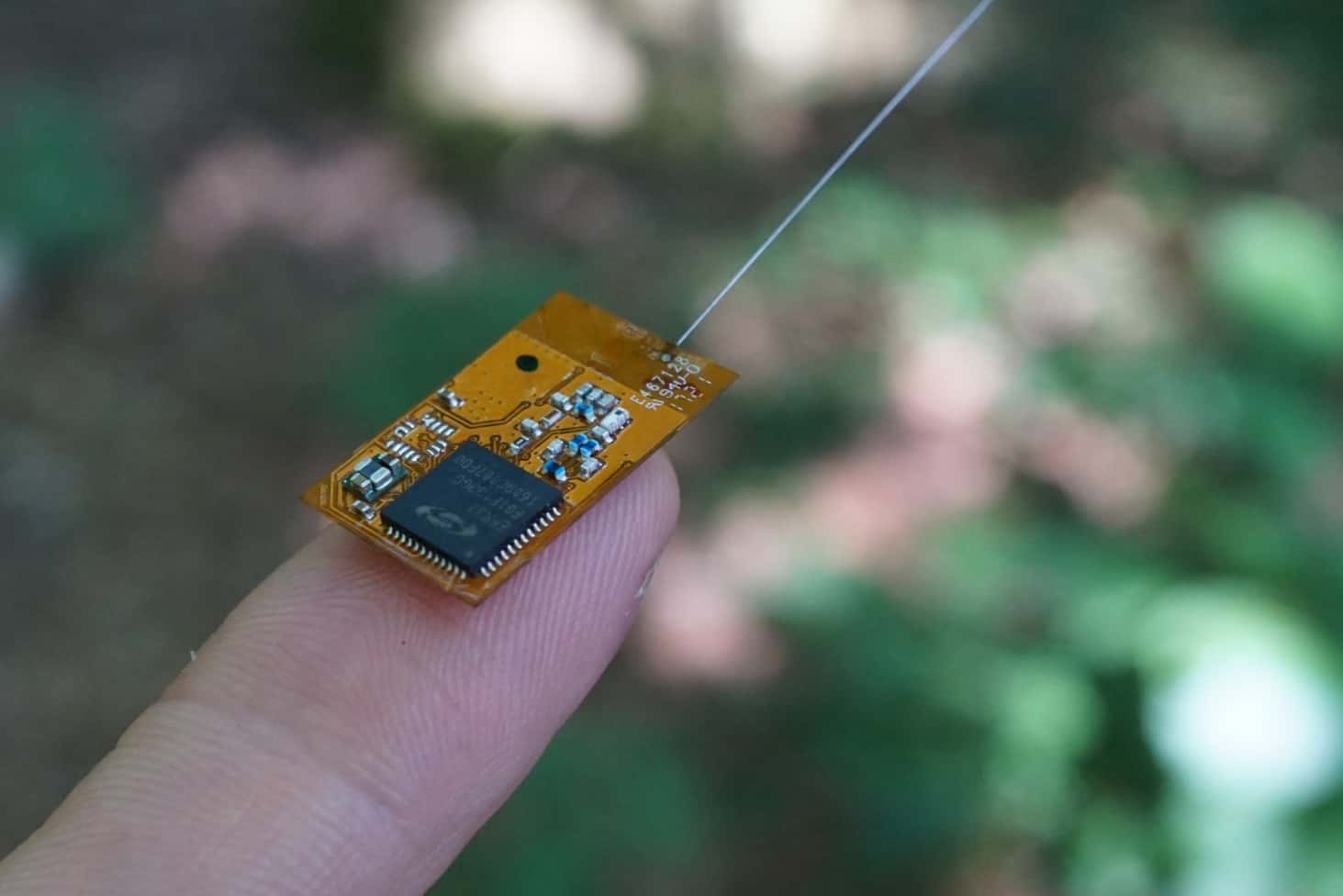
Looking out my window at the garden during this lock down, I am a bit envious of the birds that are free to come and go as they please. But what if I wanted to know what that fat wood pigeon gets up to when it is not feasting on my newly seeded lawn.
Simon Ripperger and colleagues at the Ohio State University have created a tiny wireless backpack computer that can be used to track animals in the wild (see figure). The device was created to study the social habits of the vampire bat, but I’m guessing it would also work on a pigeon.
Has it really been ten years since the Large Hadron Collider (LHC) at CERN started taking data? To celebrate a decade of achievement, Sarah Charley has charted progress at CERN in numbers.
Did you know that since 2010, exactly 2947 summer students have worked at CERN? They probably played a role in drinking the 10 million cups of coffee served at CERN restaurants in the past decade and hopefully had a hand in producing 2725 scientific papers.
Collisions at the LHC produced about 8 million Higgs particles, at least according to the Standard Model, and physicists had to sift through 278 petabytes of data to find a few Higgs to study.
Another figure that Charley came up with is the total mass of all the protons that have whizzed around the LHC since 2010. Any guesses?
You can find the answer in “10 years of LHC physics, in numbers” which appears in Symmetry.